Women's Thinning
PCOS hair loss: what helps and when to seek advice
A Healthline guide highlights treatments for hormone-related thinning, but supplement evidence is limited and a PCOS diagnosis does not explain every episode of shedding.

By Eleanor Marsh, Health Editor
Published · 5 min read
Quick answerPCOS hair loss can develop when androgen hormones contribute to thinning on the scalp. Treatments such as topical minoxidil and, for some women, prescribed hormonal medicines may help, but the cause of thinning should be assessed before choosing treatment.
Women experiencing hair thinning alongside polycystic ovary syndrome (PCOS), a condition affecting hormones and ovarian function, have treatment options, but not every approach has equally strong evidence. A Healthline guide brings together medicines, supplements and cosmetic support, highlighting a distinction: treating the underlying hormonal condition and encouraging scalp hair growth are not necessarily the same thing.
For UK readers, another distinction matters. The guide describes US medicines regulation and costs, which do not establish what is licensed, suitable or available through the NHS. Treatment decisions also depend on the pattern of hair loss, other symptoms and pregnancy plans.
What happened
Healthline’s overview describes how PCOS can be associated with female pattern hair loss, a gradual reduction in scalp hair density. It discusses both medicines applied to the scalp and prescriptions that reduce androgen activity. Androgens are hormones, including testosterone, that occur naturally in women as well as men.
This is treatment guidance rather than a report of a new clinical trial. Its recommendations draw on different types of evidence, including research on female pattern hair loss generally and smaller studies of supplements. Those findings should not be treated as interchangeable proof of effectiveness specifically in women with PCOS.
Establishing what is causing the thinning
A PCOS diagnosis does not rule out other explanations for shedding. Iron deficiency, thyroid disease, recent illness and some medicines can affect hair. More than one cause can be present, so an assessment should consider when the change began and whether it is gradual, sudden, diffuse or patchy.
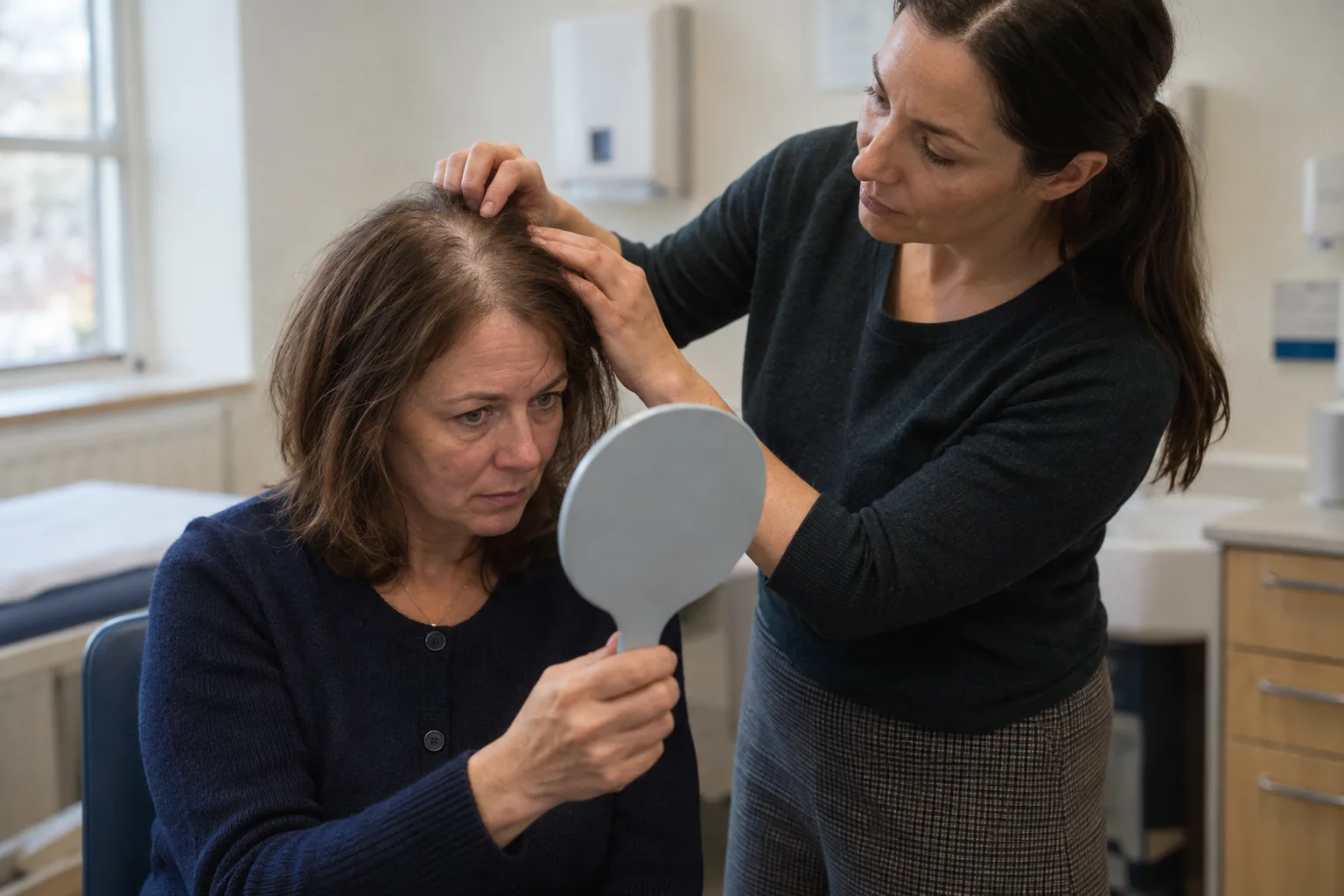
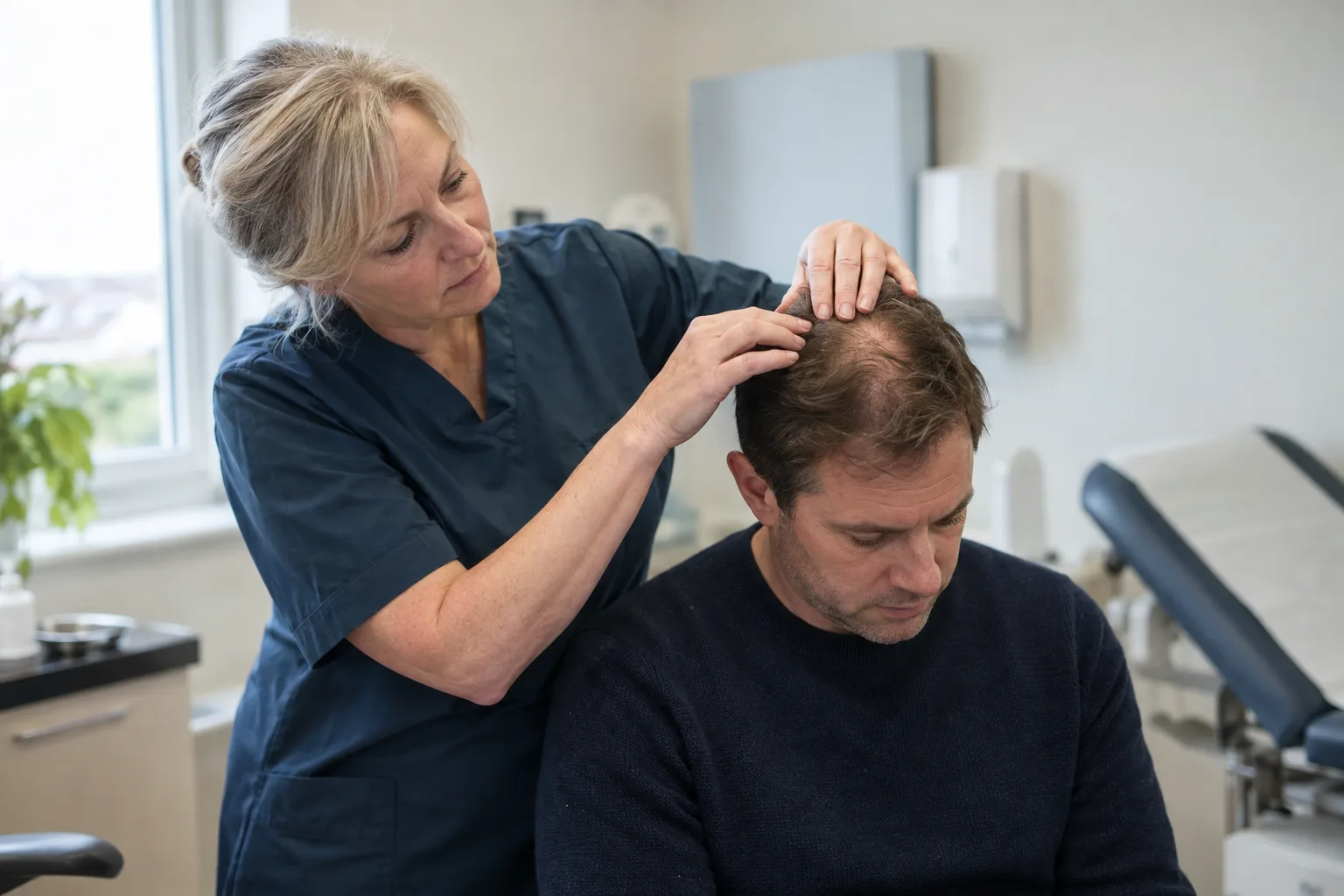
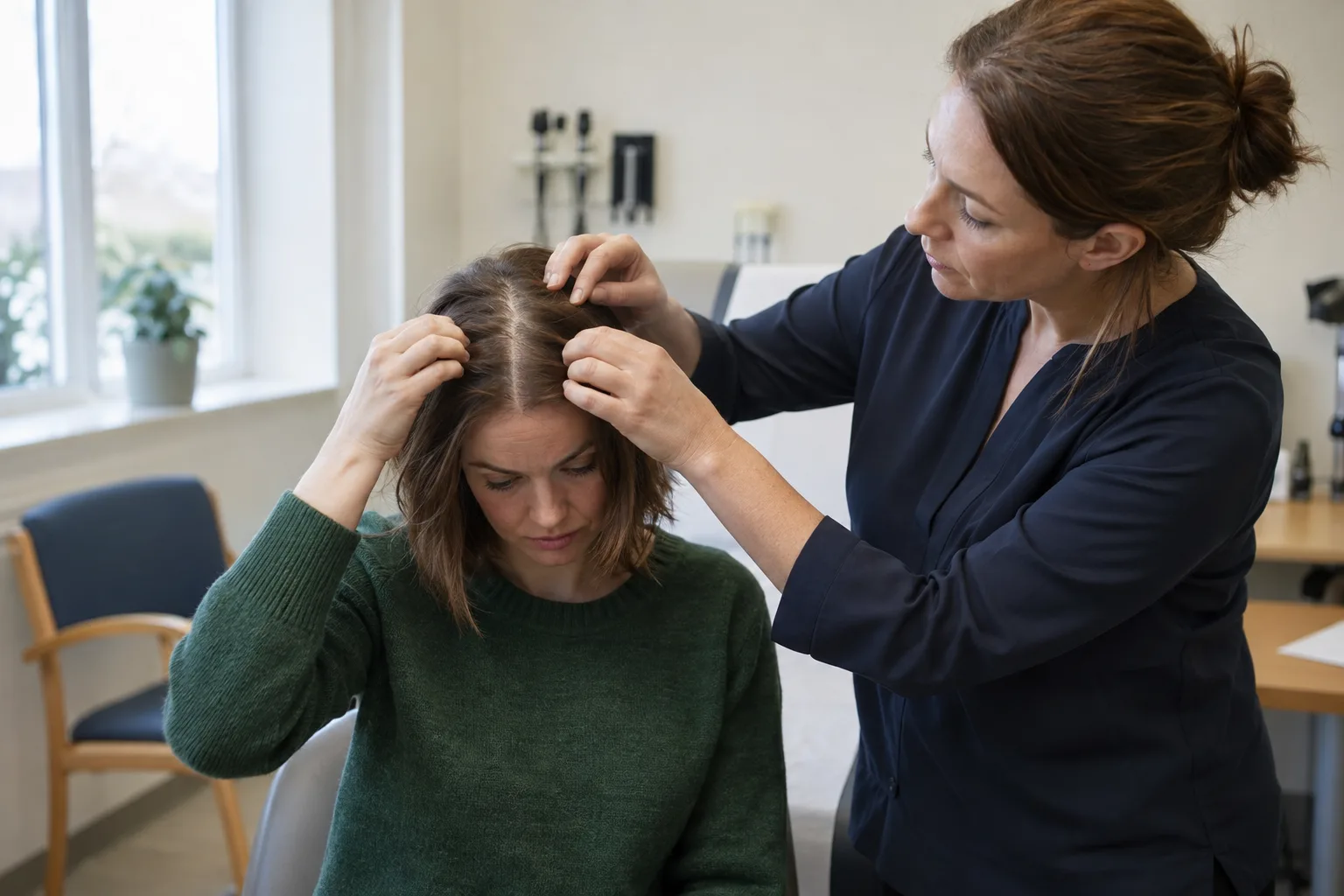
A GP may examine the scalp, review medicines and ask about periods, diet and recent health changes. Blood tests may be appropriate depending on that history. Hair thinning alone does not establish a PCOS diagnosis, and a hormone result cannot, by itself, explain every change in hair density.
Gradual thinning around the central parting and crown is more consistent with female pattern loss than a suddenly appearing bare patch. Our guide to female pattern baldness, its signs and treatment options explains this pattern. Pain, marked redness, scaling or an unusually smooth, shiny area warrants medical review because other scalp conditions require different care.
The background
Hair follicles, the structures in the skin that produce hairs, respond differently to hormones depending on their location. Increased androgen activity can encourage thicker facial or body hair while contributing to finer scalp hair. This helps explain why apparently opposite changes can happen in the same person.
In female pattern hair loss, affected follicles gradually produce shorter, finer hairs. This process is called miniaturisation. The scalp may become more visible even without dramatic handfuls of hair appearing in the shower. Genetic susceptibility also matters, and not everyone with PCOS develops scalp thinning.
Raised androgen levels are not found in every woman with female pattern loss. Follicles’ sensitivity to hormones can be relevant too. This is why treatment is guided by the overall clinical picture rather than an assumption that everyone needs the same hormone-blocking medicine.
Pattern thinning is different from temporary shedding
Telogen effluvium is increased shedding after more hairs than usual enter the resting stage of their growth cycle. It can follow illness, childbirth, substantial dietary restriction or other physical stresses. Unlike progressive miniaturisation, this form of shedding often improves after its trigger has resolved.
The timing can be misleading because shedding may begin months after the triggering event. Our explanation of postpartum hair loss and when to seek advice explores that delay. A woman with PCOS can also experience postpartum shedding, so the existing diagnosis should not automatically determine the explanation.
Medicine-related shedding is another possibility to discuss, without stopping a prescribed treatment independently. Our coverage of isotretinoin and hair loss describes one example. A medication review can help establish whether the timing fits and whether another explanation is more likely.
What people are saying
Healthline identifies topical minoxidil, a medicine applied to the scalp, as an established treatment for female pattern hair loss. It can support growth without treating PCOS itself. Improvement usually takes several months, results vary, and continued use is generally needed to maintain any benefit.
Minoxidil can cause scalp irritation and an initial increase in shedding; unwanted facial hair is another possible effect. It is generally avoided during pregnancy and breastfeeding. A pharmacist or clinician can advise on suitability, particularly where the diagnosis is uncertain or the scalp is sore or inflamed.
Healthline also discusses combined oral contraceptives and spironolactone. The combined pill can reduce androgen activity and help some other PCOS symptoms, but it is not suitable for everyone. Spironolactone blocks androgen effects and is sometimes prescribed off-label for hair loss, meaning outside its licensed indications.
Spironolactone requires a prescribing clinician’s assessment because it can affect blood pressure, kidney function and potassium levels. Anti-androgen treatment needs particular caution where pregnancy is possible. Finasteride and dutasteride are not routine first-line treatments for women: evidence is more limited, and pregnancy risks are important.
What the supplement studies can tell us
A 2016 trial cited by Healthline reported improvements in hair loss and excess body hair after eight weeks of zinc supplementation in women with PCOS. That short-term finding does not establish reliable, lasting scalp regrowth or justify routine zinc use. Excess zinc can cause harm, including copper deficiency.
The guide also cites a 2015 study of a marine-protein supplement containing biotin in women who reported thinning hair. It was not a test of biotin alone or a PCOS-specific treatment trial. Biotin can interfere with some blood tests, so readers should tell clinicians about any supplements they take.
Healthline discusses weight management as another way of improving PCOS symptoms for some people. Improvements in metabolic health or androgen levels do not guarantee hair regrowth. PCOS occurs across body sizes, and rapid weight loss or inadequate nutrition can themselves trigger shedding.
What happens next
A useful first appointment starts with a short history: when thinning began, whether periods have changed, any new medicines, recent illness and pregnancy plans. Photographs taken over time can help show changes that are difficult to judge day to day. Bring supplement details as well as prescription information.
Treatment goals should be explicit. Slowing further thinning may be worthwhile even if full density does not return. Agreeing when to review progress helps avoid changing treatments too quickly. A dermatologist can assess an uncertain diagnosis or discuss options when initial treatment has not helped.
Before paying for procedures, ask what evidence applies to your diagnosis and what ongoing costs are involved. Our report on PRP for hair loss and the limits of the evidence examines platelet-rich plasma injections. A hair transplant, meanwhile, redistributes existing follicles; it does not correct the hormonal factors associated with PCOS.
Cosmetic support remains a valid choice alongside treatment or instead of it. Hair fibres, a different parting or a well-fitted topper can reduce visible thinning without changing follicle growth. Avoiding tight styles limits additional pulling. Support groups may offer practical reassurance, but personal success stories cannot predict another person’s response.
Why this matters
Hair loss care can involve recurring private costs, and UK readers should not assume that a treatment mentioned in a US guide is NHS-funded. Our guide to NHS wigs, entitlement and help with charges explains one source of practical support. Speak to a GP if thinning is progressing, the scalp is uncomfortable or worry is affecting daily life. A dermatologist can investigate the diagnosis; a suitably qualified trichologist can offer hair and scalp advice, but is not necessarily a medical prescriber.
Common questions
- Can PCOS cause hair loss and facial hair at the same time?
- Yes. Androgen hormones can encourage facial and body hair growth while contributing to finer hair on the scalp. Hair follicles respond differently depending on their location.
- Does a widening parting mean I have PCOS?
- No. A widening parting can indicate female pattern hair loss, but it does not diagnose PCOS. A GP considers other symptoms and may arrange tests depending on your history.
- Does minoxidil help PCOS hair loss?
- Topical minoxidil can help female pattern hair loss, including when it occurs alongside PCOS. It does not treat PCOS itself, and results vary. A pharmacist or clinician can advise whether it is suitable.
- How long does treatment for PCOS hair loss take?
- Hair-growth treatment usually needs several months before improvement can be assessed. Slowing further thinning may be a useful result even without full regrowth. Agree a review point with your clinician.
- Is biotin proven to help PCOS hair loss?
- No. The study discussed here tested a supplement containing several ingredients, not biotin alone, and was not specific to PCOS. Biotin can also interfere with some blood tests.
- Can losing weight make PCOS hair grow back?
- Weight management may improve PCOS symptoms for some people, but it does not guarantee hair regrowth. PCOS occurs across body sizes, and rapid weight loss or inadequate nutrition can trigger additional shedding.
- When should I see a GP about PCOS hair loss?
- See a GP if thinning is progressing, the diagnosis is unclear or it is affecting your wellbeing. Sudden patches, pain, redness, scaling or shiny areas of scalp also need assessment rather than being assumed to be PCOS-related.
About the writer
Eleanor MarshHealth Editor · London
Eleanor leads the Thicker Thinking newsroom and has spent more than 15 years reporting on health and medical research for UK readers.
More from EleanorSources
This article is original reporting by Thicker Thinking based on the sources above. Last reviewed 8 October 2026. It is for general information and is not medical advice. Speak to your GP, a dermatologist or a qualified trichologist about your own situation.