Research and Studies
Early male pattern baldness: study explores family PCOS link
A research review links male relatives of women with PCOS to modestly higher rates of baldness, raising questions about shared inherited risks.

By Priya Nair, Research Correspondent
Published · 5 min read

Quick answerEarly male pattern baldness may share inherited risk factors with PCOS and metabolic problems, but the evidence does not prove causation. A receding hairline alone cannot diagnose diabetes, insulin resistance or a proposed male equivalent of PCOS.
Family history of polycystic ovary syndrome (PCOS), a condition affecting hormones and metabolism, may offer clues to male pattern baldness. According to Men's Health UK, a 2025 research review found modestly higher rates of this type of hair loss among close male relatives of women with the condition.
The finding raises a question about shared inherited risks, rather than providing a single explanation for why some men lose hair young. It does not mean that a mother's or sister's health causes a man's baldness, or that thinning hair indicates an underlying metabolic illness.
What happened
The review, published in Basic and Clinical Andrology, was a meta-analysis: research that combines results from several studies. It examined male first-degree relatives of women with PCOS, meaning fathers, brothers and sons. Alongside the hair-loss association, researchers reported higher fasting glucose, cholesterol and blood pressure, according to Men's Health UK.
These measurements describe different aspects of health. Fasting glucose measures blood sugar after a period without food, while cholesterol is a fatty substance carried in the blood. Blood pressure measures the force of blood against artery walls. They are relevant to diabetes and cardiovascular risk, but none is a test for the cause of baldness.
The news report does not give the review's participant count, the size of the baldness association or the uncertainty around that estimate. Its description of a modest increase therefore cannot tell readers how much an individual man's risk might change. Group differences also do not mean that every relative has abnormal results.
Most importantly, an association cannot establish cause and effect. Relatives can share genes, environments and habits. To identify whether particular inherited factors connect hair loss and metabolic health, researchers need to distinguish these influences and account for factors such as age and body weight.
The report also does not establish a particular age at which baldness becomes a metabolic warning sign. Evidence about male relatives as a group should not automatically be treated as proof of why an individual started losing hair in his teens or twenties.
The background
Male pattern baldness, also called androgenetic alopecia, usually produces a gradually receding hairline, thinning at the crown, or both. In susceptible hair follicles, the structures in the skin that grow hair, successive hairs become finer and shorter. Our guide to male pattern baldness, its signs and treatment options explains how this pattern is recognised.
A key influence is sensitivity to dihydrotestosterone, or DHT, a hormone made from testosterone. Genetic susceptibility helps determine how follicles respond. Pattern hair loss can therefore develop without unusually high testosterone levels, and its appearance alone cannot reveal someone's wider hormone profile.
Inheritance is also more complicated than the familiar claim that baldness comes only from the mother's side. Many genetic variants contribute, and relevant family history can come from either parent. A relative's diagnosis is useful information for a clinician, not a prediction of an inevitable outcome.
PCOS can involve irregular ovulation, signs of increased androgen activity and a characteristic ovarian appearance. Androgens are hormones, including testosterone, present in everyone. Some people with PCOS have acne or scalp hair thinning; others do not. Diagnosis depends on a clinical assessment rather than one definitive blood test.
The condition is also associated with insulin resistance, when the body responds less effectively to the hormone that helps regulate blood sugar. This can increase the risk of type 2 diabetes. That broader metabolic component helps explain researchers' interest in relatives who do not have ovaries.
Men's Health UK uses the term polyendocrine metabolic ovarian syndrome, shortened to PMOS, and describes a naming change intended to emphasise wider effects. This article retains the familiar term PCOS. Whatever terminology is used, a revised name would not itself establish diagnostic criteria for men.
Not every change in hair has the same biology. Greying concerns pigment, whereas pattern baldness involves changes in follicle growth. Our examination of stress and grey hair research covers a separate question; evidence about one hair change should not be used to explain another automatically.
What people are saying
The specialists quoted in Men's Health UK offer possible interpretations and clinical advice, rather than evidence from a new treatment trial. Endocrinologist Gillian Goddard, a doctor specialising in hormones, describes the possibility that inherited factors associated with PCOS in women also influence baldness and metabolic disease in men.
Dermatologist Viktoryia Kazlouskaya adds an important qualification: a male equivalent of the syndrome remains a relatively new concept, not an established medical diagnosis. This distinction matters because a research hypothesis cannot yet provide a reliable label for someone attending a hair-loss clinic.
Fertility specialist Leo F. Doherty advises against rushing to request genetic testing. Instead, he suggests discussing checks for hormonal or metabolic abnormalities with a doctor when appropriate. His comments point towards assessing measurable health risks rather than seeking confirmation of an undefined syndrome.
Dermatologist Corey Hartman discusses finasteride and oral minoxidil as hair-loss treatments in the report. These are clinical suggestions, not findings from the meta-analysis. The review does not establish that either medicine improves metabolic health, or that men with a family history of PCOS need a different hair-loss treatment plan.
What happens next
For research, a central question is whether early baldness adds useful information beyond established risk factors for metabolic illness. Studies following people over time could help clarify whether hair loss precedes changes in blood sugar, and whether considering it improves decisions about screening. The supplied report gives no timetable for such work.
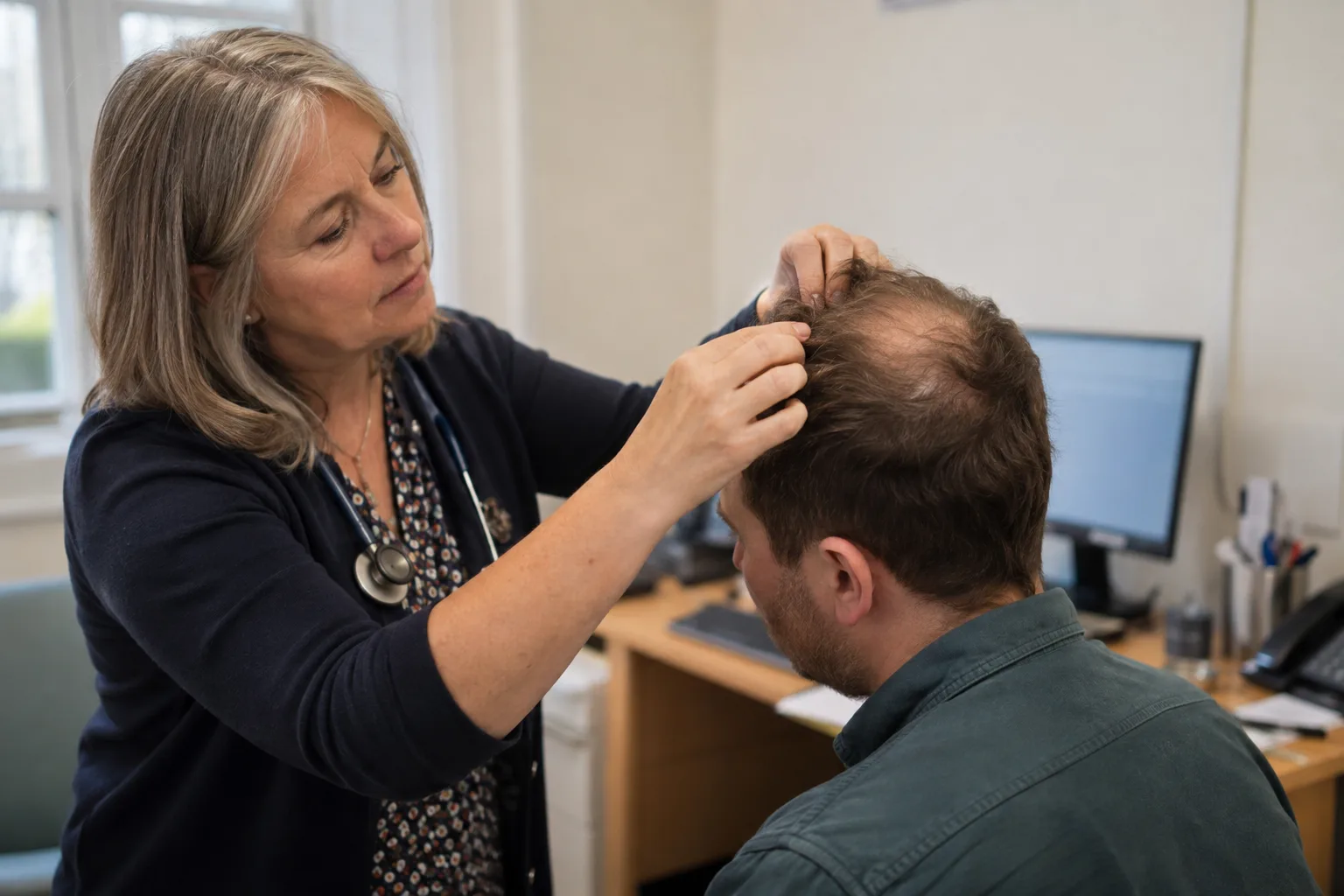
For an individual assessment, useful details include when thinning began, whether it is gradual or sudden, its distribution, current medicines and relevant family diagnoses. A GP can consider these alongside symptoms and existing risks, then decide whether blood pressure measurement or blood tests would be helpful. Broad hormone or genetic testing is not automatically necessary.
A medication history can also change the explanation. Some medicines are associated with diffuse shedding rather than the typical pattern of androgenetic alopecia. Our guide to isotretinoin-associated hair loss describes one example. Do not stop prescribed treatment without discussing concerns with the prescriber.
Hair-loss treatment needs its own benefit–risk discussion. Finasteride reduces DHT production and can cause side effects, including sexual problems and mood changes. Topical minoxidil is another established option. Oral minoxidil is prescribed off-label for hair loss in the UK, meaning outside its licensed indication, and requires medical oversight because it can affect blood pressure and cause fluid retention.
Exercise, a balanced diet and support with identified blood pressure, cholesterol or blood sugar problems can benefit general health. They should not be presented as proven ways to reverse inherited baldness. Likewise, treating hair loss does not replace appropriate care for a diagnosed metabolic condition.
Sudden shedding, distinct bald patches, scalp pain or inflammation deserve assessment rather than being assumed to be male pattern baldness. A GP or dermatologist can investigate medical causes; a trichologist can offer hair and scalp advice, although trichologists are not necessarily medically qualified.
Related: Male pattern baldness: signs, treatment and when to seek help
Why this matters
For people losing hair young, the useful message is that family medical history may add context to a consultation, not that baldness requires a new disease label. In the UK, a GP can weigh that history against established health risks and arrange checks where appropriate. Seek advice if hair loss is rapid, unexplained, accompanied by scalp symptoms or affecting your wellbeing. A dermatologist can assess the diagnosis and treatment options; our guide to seeking help for male pattern baldness explains the usual starting points.
Common questions
- Is early male pattern baldness linked to PCOS?
- There may be shared inherited links. A 2025 meta-analysis reported modestly higher rates of male pattern baldness among male first-degree relatives of women with PCOS, but it did not establish what causes an individual's early hair loss.
- Can men have PCOS?
- A proposed male equivalent of PCOS is not an established medical diagnosis. Researchers are exploring whether some men share inherited hormonal and metabolic features associated with the condition in women.
- Does going bald young mean I have diabetes?
- No, early baldness does not diagnose diabetes. A GP can assess symptoms, family history and other risk factors to decide whether blood sugar testing would be appropriate.
- Should I get a genetic test if my sister has PCOS?
- A sister's PCOS diagnosis does not automatically justify genetic testing. The specialists quoted in the report recommend discussing relevant health risks with a doctor rather than seeking a genetic test for a proposed male syndrome.
- Is baldness only inherited from your mother's side?
- No, genetic susceptibility to male pattern baldness can come from either parent. Many genetic variants contribute, so one relative's hair loss or medical diagnosis cannot reliably predict your own outcome.
- Does male pattern baldness mean high testosterone?
- No, male pattern baldness can develop without unusually high testosterone. The sensitivity of susceptible follicles to DHT, a hormone made from testosterone, is an important influence.
- Is oral minoxidil licensed for hair loss in the UK?
- Oral minoxidil is prescribed off-label for hair loss in the UK, outside its licensed indication. It needs medical oversight because it can affect blood pressure and cause fluid retention.
About the writer
Priya NairResearch Correspondent · Cambridge
Priya translates new hair and scalp research into plain English, explaining how studies were done and how much weight they deserve.
More from PriyaSources
This article is original reporting by Thicker Thinking based on the sources above. Last reviewed 7 October 2026. It is for general information and is not medical advice. Speak to your GP, a dermatologist or a qualified trichologist about your own situation.