Men's Hair Loss
Male pattern baldness: signs, treatment and when to seek help
Recognising the pattern can help men choose appropriate care, avoid unsuitable products and understand what treatment can realistically achieve.

By Tom Fairbairn, Men's Health Reporter
Published · 5 min read
Quick answerMale pattern baldness is inherited hair loss that usually causes a receding hairline or thinning at the crown. Treatments can slow its progress for some men, but sudden, patchy or painful hair loss needs assessment for other causes.
Male pattern baldness affects more than half of men over 50 to some degree, according to a US National Library of Medicine estimate cited by Healthline. Yet recognising common thinning is only part of the picture: the timing, distribution and condition of the scalp help determine whether another cause needs checking.
For men weighing treatment, the distinction matters. Medicines may help preserve hair or encourage some regrowth, but they do not offer a guaranteed return to previous thickness. A diagnosis also helps separate a personal choice about appearance from hair loss that needs medical investigation.
What happened
Healthline’s explainer brings together the causes, signs and management of male pattern baldness, medically known as androgenetic alopecia. The supplied article was medically reviewed in June 2019; it is background guidance, not a report of a new trial or treatment approval.
Its central clinical distinction is between gradual, patterned thinning and loss accompanied by other changes. Temples that recede over time, sometimes leaving an M-shaped hairline, and an increasingly visible crown are characteristic. These areas can eventually join, while hair around the sides and back often remains.
By contrast, scalp redness, scaling, pain, broken hairs or distinct bare patches deserve assessment rather than an assumption that this is ordinary balding. A person can also have more than one cause of hair loss at the same time, making appearances alone an imperfect guide.
Medication history is another useful clue. Hair loss that follows a new prescription should be discussed with the prescriber, without stopping treatment independently. Our guide to hair loss associated with isotretinoin treatment explores one medicine-related concern that is different from inherited thinning.
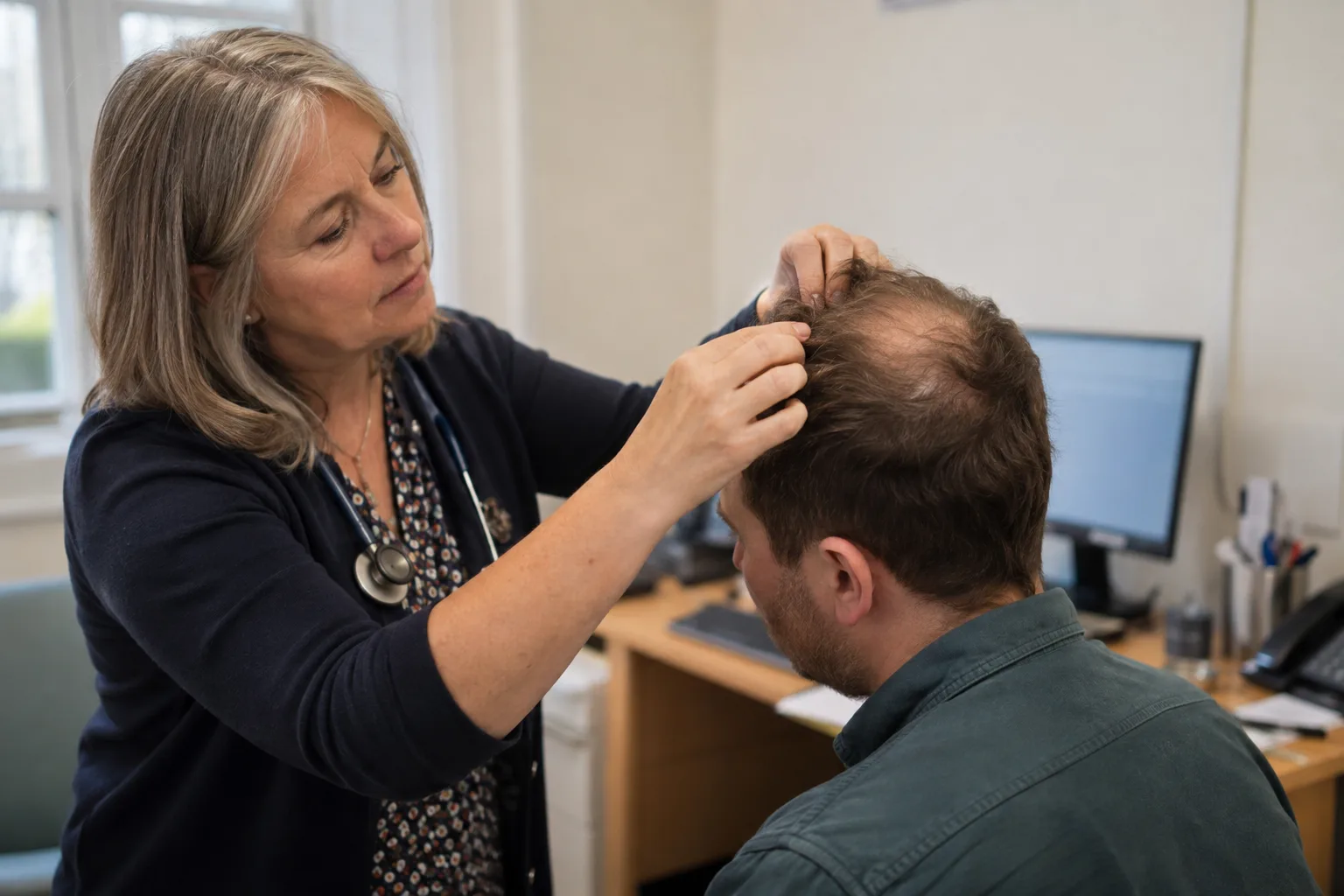
A clinician will usually begin with questions about when the change started, family history, recent illness and other symptoms, alongside a scalp examination. Blood tests may be appropriate if thyroid disease or a nutritional deficiency is suspected. A scalp biopsy, which removes a small skin sample for examination, is reserved for situations where the diagnosis remains uncertain.
The background
Why the hair becomes finer
Androgens are hormones involved in sexual development and other bodily functions, including hair growth. In susceptible scalp follicles — the structures from which hairs grow — a hormone called dihydrotestosterone, or DHT, contributes to progressive shrinkage. This process is known as miniaturisation.
The growing phase becomes shorter, and successive hairs may be finer and less visible. This explains why pattern hair loss can first appear as reduced coverage rather than dramatic shedding. It does not necessarily mean that someone has unusually high levels of testosterone.
Risk increases with age, although changes can begin during the teenage years. Inheritance is complex and involves genes from both sides of the family, not only the mother’s side. A relative’s experience may offer a clue, but cannot reliably predict when another person will lose hair or how far it will progress.
Researchers also explore whether early thinning accompanies other inherited traits. Our report on early male pattern baldness and a possible family PCOS link covers one such question. Exploratory associations are not proof of causation and should not be treated as an individual diagnosis.
Where stress fits
Stress can contribute to a different process called telogen effluvium, in which more hairs enter the resting phase and shedding becomes noticeable across the scalp. It may follow significant illness or emotional strain, often with a delay. It is not the same mechanism as gradual follicle miniaturisation.
Healthline mentions a theory connecting stress, hormone production and baldness, but that should not be read as evidence that relaxation prevents inherited hair loss. Claims about stress need to be specific about the outcome being studied; our examination of stress and grey hair research considers a separate change in hair pigmentation.
What people are saying
Healthline presents treatment as optional when another health condition is not responsible. That is an important distinction: choosing not to treat male pattern baldness is medically reasonable. The supplied article reports no new patient interviews or expert reactions, so it cannot establish how particular men feel about their options.
Its discussion of counselling recognises that appearance changes can nevertheless affect wellbeing. Hair loss may influence confidence, relationships or social activity without being physically painful. Support for anxiety or low mood can be worthwhile in its own right, whether or not someone pursues hair treatment.
What the established medicines offer
Topical minoxidil, a medicine applied to the scalp, can improve growth or slow loss for some men. Healthline describes visible changes over roughly four months to a year. Response varies, and a fuller-looking result is not assured; maintaining existing coverage may itself be a useful outcome.
Minoxidil can cause dryness, irritation or flaking. Temporary increased shedding can also occur when treatment begins. Chest pain or difficulty breathing requires urgent medical help, while palpitations or swelling need prompt assessment rather than being dismissed as a normal adjustment.
Finasteride is a prescription medicine that reduces DHT production. Its effects also take months to judge. Possible adverse effects include sexual difficulties and mood changes. UK medicines guidance warns about depression, suicidal thoughts and sexual side effects that may persist after stopping, making a discussion of personal risks important before treatment.
Finasteride can also lower prostate-specific antigen, or PSA, a substance measured in some prostate blood tests. Anyone taking it should tell the clinician arranging or interpreting that test. With either medicine, benefits generally diminish after treatment ends because the underlying tendency to lose hair remains.
What happens next
Turning information into a personal plan
For someone considering treatment, the next step is to establish what is causing the change and what outcome matters most. Preserving coverage, improving appearance without medicine and simply understanding the diagnosis are different goals. A GP or dermatologist can help assess medical causes and treatment suitability; a trichologist can offer hair and scalp advice, although qualifications vary.
Taking occasional photographs with similar lighting, hairstyle and camera position can make gradual changes easier to judge. Daily mirror checks are less reliable because wetness, styling and overhead light can alter how much scalp is visible. Bring a medication list and a rough history of the changes to an appointment.
A haircut, hair fibres or a well-fitted hairpiece can alter appearance without changing follicle biology. Attachments that repeatedly pull on existing hair can cause traction alopecia, meaning hair loss from tension. Comfort and the condition of the underlying scalp matter when choosing concealment options.
Hair transplantation moves follicles from a donor area to places with less coverage. It is surgery, with risks including infection and scarring, and donor hair is limited. Although transplanted follicles may provide lasting growth, surrounding untreated hair can continue thinning, so long-term planning is essential.
In the UK, treatment for uncomplicated male pattern baldness is generally paid for privately rather than provided by the NHS. Before committing, ask about total ongoing costs, expected benefits, side effects and review arrangements. There is no proven way to prevent inherited susceptibility, and a commercial promise of guaranteed regrowth is not a substitute for clinical assessment.
Related: Minoxidil for children: expert guidance sets out evidence gaps
Why this matters
For UK readers, identifying the cause before spending money can prevent months of unsuitable treatment and help uncover a treatable scalp or health problem. Our guide to isotretinoin and hair loss illustrates why a medication review can sometimes be relevant. Speak to a GP if loss is sudden, patchy, painful or accompanied by other symptoms, or if it is affecting your wellbeing. A dermatologist can investigate uncertain diagnoses, while a suitably qualified trichologist can provide additional hair and scalp advice.
Common questions
- What does male pattern baldness look like at the start?
- It often starts with gradual recession at the temples or thinning at the crown. The hairline may become M-shaped, and reduced coverage can appear before noticeable shedding.
- Does baldness come from your mum or dad?
- Genes from both sides of the family can contribute to male pattern baldness. Inheritance is complex, so one relative’s hairline cannot reliably predict your own.
- Can stress cause male pattern baldness?
- Stress is not established as the cause of inherited male pattern baldness. It can trigger telogen effluvium, a separate form of widespread shedding that may occur alongside patterned thinning.
- How long does minoxidil take to work for men?
- Visible changes can take roughly four months to a year, according to Healthline. Results vary, and some men gain better maintenance of existing hair rather than substantial regrowth.
- Does hair loss come back after stopping treatment?
- Hair loss generally resumes after minoxidil or finasteride is stopped, and treatment-related gains can be lost. Neither medicine removes the inherited tendency towards thinning.
- What are the risks of finasteride for hair loss?
- Finasteride can cause sexual difficulties and mood changes. UK medicines guidance warns about depression, suicidal thoughts and sexual side effects that may persist after stopping; discuss personal risks with the prescriber.
- When should I see a GP about hair loss?
- See a GP for sudden or patchy loss, scalp pain, redness, scaling, or hair loss alongside other symptoms. It is also worth seeking advice if changes follow medication or affect your wellbeing.
- Is male pattern baldness treatment available on the NHS?
- Treatment for uncomplicated male pattern baldness is generally not provided by the NHS and is usually paid for privately. A GP can still help assess the cause of hair loss.
About the writer
Tom FairbairnMen's Health Reporter · Edinburgh
Tom covers male pattern hair loss, treatments and the growing online market, cutting through the marketing to the evidence.
More from TomSources
This article is original reporting by Thicker Thinking based on the sources above. Last reviewed 7 October 2026. It is for general information and is not medical advice. Speak to your GP, a dermatologist or a qualified trichologist about your own situation.