Men's Hair Loss
Alopecia barbae: what beard bald patches mean and what helps
Beard hair loss can have several causes, and evidence for treatments needs careful interpretation before choosing medicines, supplements or home remedies.

By Hannah Lloyd, Women's Health Writer
Published · 6 min read
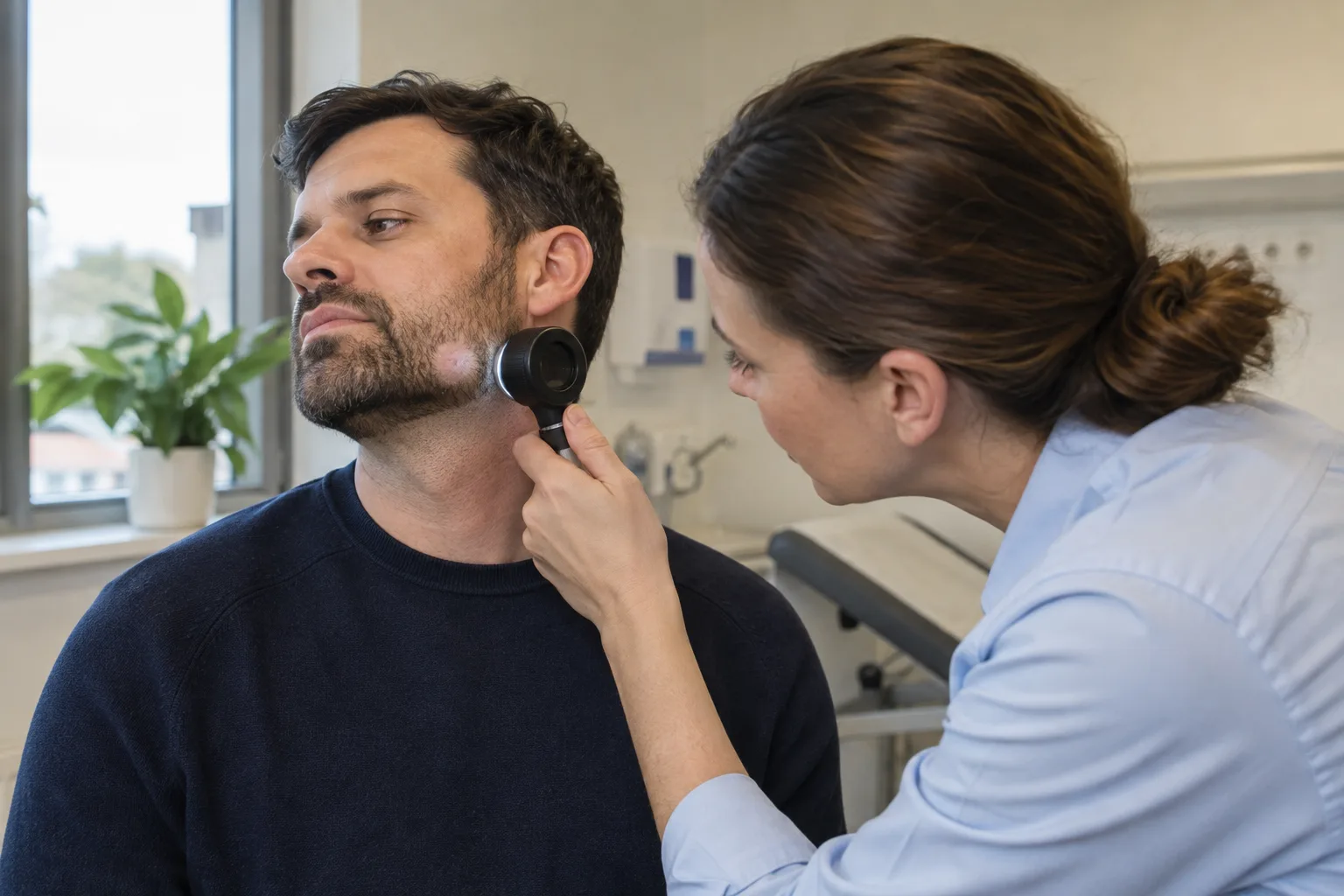
Quick answerAlopecia barbae is a form of alopecia areata in which the immune system targets beard hair follicles, causing bald patches. Hair can regrow, but treatment results vary, and new or spreading patches should be assessed by a GP or dermatologist.
Sudden gaps in a beard can be a sign of alopecia barbae, an immune-related condition that needs a different assessment from ordinary scalp thinning. Healthline’s updated explainer describes treatments that may encourage regrowth, while highlighting uncertainty around home remedies and supplements.
For men deciding what to do about a new patch, the important distinction is between recognising a possible symptom and confirming its cause. Beard hair loss is not always alopecia barbae, and choosing a treatment before checking the skin can mean overlooking an infection or another condition.
What happened
Healthline’s article, updated on 11 February 2026, brings together information on beard alopecia, its diagnosis and available treatments. It is an overview rather than an announcement of a new trial, so the options it discusses should not be read as a newly proven treatment programme.
Alopecia barbae typically produces rounded areas without hair, often around the jaw. According to Healthline, these can appear over days or weeks and may join together as hair loss progresses. Some people lose hair only from their beard; others develop patches on the scalp or elsewhere.
A clinician will look at both the distribution of the missing hair and the skin underneath. Short hairs that narrow towards the skin, sometimes called exclamation-mark hairs, can support a diagnosis of alopecia areata. Their absence does not, by itself, rule it out.
The examination also helps distinguish autoimmune hair loss from conditions needing different care. Fungal infection of the beard area can cause inflammation and broken hairs, for example. Marked scaling, crusting or tenderness should not simply be assumed to be part of alopecia.
Healthline says further investigations can include examination of hair samples, blood tests or a skin biopsy, in which a small tissue sample is assessed. These are not automatic requirements for every patch: the history and examination guide whether additional testing is useful.
The background
Alopecia areata is an autoimmune condition, meaning the immune system mistakenly attacks part of the body. In beard alopecia, the target is the hair follicle, the structure within the skin that produces a hair. This disrupts growth rather than following the usual pattern of age-related thinning.
It is generally a non-scarring form of hair loss: the follicles are not permanently replaced by scar tissue. That leaves the possibility of future growth, although it does not guarantee that every affected area will recover. Alopecia barbae itself is not contagious.
This differs from androgenetic alopecia, the inherited, hormone-sensitive process behind most male pattern baldness. Our guide to male pattern baldness signs and treatment explains that condition. A receding hairline and a suddenly bare beard patch should not automatically be treated as the same problem.
The precise reasons why someone develops alopecia areata remain uncertain. Healthline describes links with family history, allergic conditions and other autoimmune illnesses. These associations do not mean that a man with beard patches necessarily has another illness or needs an extensive panel of tests.
Physical or psychological stress may be associated with episodes, but it is often impossible to identify a single trigger. Hair loss is not evidence that someone has failed to manage stress. Research about stress and grey hair concerns a different biological outcome and cannot explain an individual’s beard loss.
The effect can also extend beyond appearance. A beard may carry cultural or religious meaning, or be closely tied to someone’s identity. Distress can be substantial even when the affected area is small, so patch size alone is not a reliable measure of how much support someone needs.
What people are saying
Healthline presents medicines alongside several widely discussed natural remedies, but the supporting research addresses different kinds of hair loss. This matters because a finding in people with thinning scalp hair cannot automatically be applied to an immune attack affecting beard follicles.
One example is a small 2007 study of garlic gel used alongside a corticosteroid cream for localised alopecia areata. According to Healthline, the combination performed better than the corticosteroid alone. However, the study was not specifically about beard alopecia and does not establish garlic as an effective treatment on its own.
Nor does research on a prepared gel justify applying raw garlic to facial skin. Raw garlic can cause irritation and burns. More broadly, an ingredient being described as natural says little about whether it is suitable for inflamed skin or safe near the eyes and mouth.
Healthline also cites a 2016 trial of a marine-based supplement in men with thinning hair. Researchers reported improved growth and reduced shedding over six months, but this was not evidence of benefit for alopecia barbae. Correcting a nutritional deficiency is a separate question from treating autoimmune disease.
Zinc and biotin are necessary nutrients, yet extra supplementation is not an established beard-alopecia treatment when levels are adequate. Supplements can interact with medicines, and biotin can interfere with some blood-test results. Tell the clinician arranging tests about anything you take, including products marketed for hair growth.
Some evidence behind the medicines also needs qualification. Healthline’s references include studies of diphencyprone and anthralin in children with alopecia areata, rather than trials specifically in adults with beard patches. Such evidence may inform practice without providing a dependable prediction for this particular group.
The same distinction is relevant when considering paid procedures. As our report on PRP for hair loss and the evidence behind it explains, findings need to be interpreted in context. Platelet-rich plasma research for one hair-loss condition is not proof that injections will restore a patchy beard.
What happens next
For confirmed localised beard alopecia, a dermatologist may consider corticosteroids applied to the skin or injected into affected areas. These medicines reduce inflammation and immune activity. Facial skin needs particular care because potential adverse effects include thinning of the skin and changes in pigmentation.
Minoxidil, a medicine that encourages hair growth, may sometimes be considered as an additional option. Its established use for pattern scalp hair loss does not make it an equivalent treatment for the underlying autoimmune process. Beard use is outside the usual licensed indication and warrants professional advice.
Other specialist approaches include diphencyprone, which deliberately produces a controlled allergic skin reaction, and anthralin, an irritant treatment also used for psoriasis. Both can cause troublesome skin reactions. Availability and suitability vary, and neither should be approached as a home experiment.
JAK inhibitors are medicines that block particular immune-signalling pathways. Healthline includes them among options for severe alopecia areata or disease that has not responded to other treatment. They require specialist assessment and monitoring; their use in severe disease does not mean they are routinely appropriate for isolated beard patches.
Whatever the approach, progress is usually assessed over months rather than days. Regrowth can be incomplete or initially differ in colour or texture, and another episode can occur after recovery. There is no guaranteed permanent cure, so an agreed review plan is more useful than a promised deadline.
Before an appointment, note when the patches appeared, whether they are changing and any recent illness, medicines or skin symptoms. Photographs taken over time can help show progression. Seek prompt medical advice if hair loss comes with fever, increasing warmth, pain or a spreading rash, which may suggest infection.
If the changes are affecting relationships, confidence or daily life, raise that alongside the physical symptoms. A GP can discuss psychological support, while the UK charity Alopecia UK offers information and peer support. Seeking that help does not depend on choosing medical treatment for the hair loss.
Why this matters
For UK readers, recognising that beard patches may need a different approach from scalp thinning can prevent spending money on unsuitable treatments. Our guide to male pattern baldness and when to seek help explains the more familiar diagnosis, but sudden beard loss deserves its own assessment. Speak to a GP or dermatologist about new, spreading or symptomatic patches, or whenever the emotional impact is difficult to manage. A trichologist can offer hair-care advice, but suspected infection and decisions about prescription medicines need medical assessment.
Common questions
- What is alopecia barbae?
- Alopecia barbae is alopecia areata affecting the beard. The immune system targets hair follicles, disrupting growth and producing patches of hair loss.
- Will my beard grow back after alopecia barbae?
- Beard hair can grow back, but recovery is unpredictable. Regrowth may be partial or differ in colour or texture, and hair loss can return after improvement.
- Is alopecia barbae contagious?
- No, alopecia barbae is not contagious. However, fungal infections can also cause beard hair loss, which is one reason to have unexplained patches assessed.
- Does stress cause bald patches in a beard?
- Stress may be associated with alopecia areata, but it does not explain every case. The exact causes are uncertain, and a bald patch is not proof that stress caused it.
- Can minoxidil treat alopecia barbae?
- Minoxidil may sometimes be considered to support growth, but it does not directly treat the underlying immune attack. Beard use is outside the usual licensed indication, so discuss suitability with a clinician.
- Does garlic help beard alopecia?
- There is not enough evidence to recommend garlic for beard alopecia. A small study tested garlic gel alongside a steroid for alopecia areata, not specifically beard loss. Raw garlic can irritate or burn skin.
- When should I see a doctor about beard bald patches?
- See a GP or dermatologist for new, spreading or unexplained beard patches. Seek prompt advice if there is fever, warmth, increasing pain or a spreading rash, as these may indicate infection.
About the writer
Hannah LloydWomen's Health Writer · Cardiff
Hannah writes about women's hair loss, from menopause and PCOS to postpartum shedding, with a calm and practical approach.
More from HannahSources
This article is original reporting by Thicker Thinking based on the sources above. Last reviewed 8 October 2026. It is for general information and is not medical advice. Speak to your GP, a dermatologist or a qualified trichologist about your own situation.