Camouflage and Styling
NHS wigs: costs, free entitlement and help with charges
NHS guidance explains who can get a free wig, how low-income support works and what paperwork is needed to claim a refund.

By Priya Nair, Research Correspondent
Published · 6 min read
Quick answerNHS wigs are not automatically free: the NHS lists charges from £80.15 to £310.55, depending on the type. Some people qualify for free wigs or reduced charges through age, circumstances, qualifying benefits or the NHS Low Income Scheme.
People considering a wig for hair loss may be able to get one free or at a reduced charge through the NHS, but entitlement depends on more than having a medical reason for losing hair. NHS guidance sets out exemptions, financial support and a route to reclaim eligible payments.
For readers weighing up camouflage options, the important distinction is between access to an NHS wig service and help paying its charges. The supplied NHS webpage was last reviewed on 30 June 2023; it is not an announcement of a new scheme. Readers should confirm charges and arrangements with their treating service before paying.
What happened
The NHS guidance brings together rules for wigs and fabric supports, such as surgical bras. This article focuses on wigs. The charging arrangements described concern England; readers elsewhere in the UK should check their local NHS service, as health-cost rules differ between nations.
For someone facing a bill, there are three separate questions: which wig is being supplied, whether an exemption applies, and whether financial assistance can reduce the amount. The prices below are listed NHS charges, not estimates of private retail costs:
- A stock modacrylic wig costs £80.15.
- A partial human hair wig costs £212.35.
- A full bespoke human hair wig costs £310.55.
Modacrylic is a synthetic fibre used to make wigs. A stock wig is ready-made, while bespoke means individually made. These categories describe different constructions and materials; price alone does not establish which option will feel comfortable or suit a person's needs.
The charging page does not set out which diagnoses qualify someone for a wig referral, which styles every service stocks, or how often a replacement can be supplied. Those are questions for the treating team or wig service rather than assumptions to make from the price list.
Nor does the guidance promise reimbursement for a wig bought independently from a private retailer. Its refund instructions specifically ask for evidence that an NHS charge was paid. Anyone hoping to use NHS financial support should clarify the purchasing route before committing money.
The background
Some exemptions depend on age or circumstances rather than income. According to the NHS, wigs are free for children under 16, people aged 16 to 18 who are in full-time education, and hospital inpatients.
War pensioners also qualify when the wig relates to their accepted disablement and they hold a valid war pension exemption certificate. The link to that accepted condition matters: being a war pensioner alone is not the complete eligibility test.
Certain benefits provide another route. The NHS lists income-related Employment and Support Allowance and Pension Credit Guarantee Credit. Universal Credit is included only where the claimant meets the relevant health-cost criteria; receiving it does not automatically settle the question.
These benefit-based rules can apply if a person's partner, including a civil partner, receives the qualifying benefit. They can also cover someone under 20 who is the dependant of a recipient. This makes household circumstances relevant, rather than just the patient's own benefit record.
People outside those groups may still qualify through the NHS Low Income Scheme. It assesses income against recognised requirements, rather than treating receipt of a particular benefit as the only way to obtain support.
Under the published rules, full help may be available when income does not exceed those requirements, or exceeds them by no more than half the current English prescription charge. A larger excess may still allow limited help. This is an eligibility calculation, not a wig-price discount applied equally to everyone.
Full help is recorded on an HC2 certificate; partial help is recorded on an HC3 certificate. Certificates normally last between six months and five years, depending on circumstances. Being entitled to, or named on, a valid HC2 certificate gives access to free NHS wigs.
Financial eligibility should be kept separate from finding the cause of hair loss. Gradual inherited thinning and increased shedding after a medicine change need different assessments. Our guides to male pattern baldness signs and when to seek help and hair loss associated with isotretinoin explain those distinctions.
What people are saying
The practical advice from the NHS is to tell the person fitting the wig if you are entitled to receive it free, and show evidence. Where relevant, that includes a war pension exemption certificate. Bringing the paperwork to the fitting gives the service the information needed to apply the correct charge.
For someone with an HC3 certificate, the NHS says the payment should be the amount specified on the certificate or the actual charge, whichever is lower. Partial help therefore has a defined limit: it should not leave someone paying more than the item itself costs.
The NHS Business Services Authority provides an eligibility checker for help with health costs. Its customer enquiry line, 0300 330 1343, can also help with questions about the Low Income Scheme and charges. This offers a way to check uncertain entitlement rather than guessing from the name of a benefit.
The source is administrative guidance, not research comparing wigs or reporting patients' experiences. It cannot tell readers which fibre looks most natural to them, how a particular cap will feel, or whether they will prefer a wig to a scarf or uncovered scalp.
Those preferences are separate from evidence about hair regrowth. A wig changes appearance without treating the underlying cause of hair loss. For comparison, our report on Harvard Health's assessment of PRP for hair loss examines the evidence for a procedure intended to support growth. Cosmetic coverage and medical treatment serve different purposes.
What happens next
For readers beginning the process, a useful first step is to ask their GP or existing hospital team whether referral to a local NHS wig service is appropriate. The supplied guidance gives no national waiting time, so appointment availability needs to be checked locally.
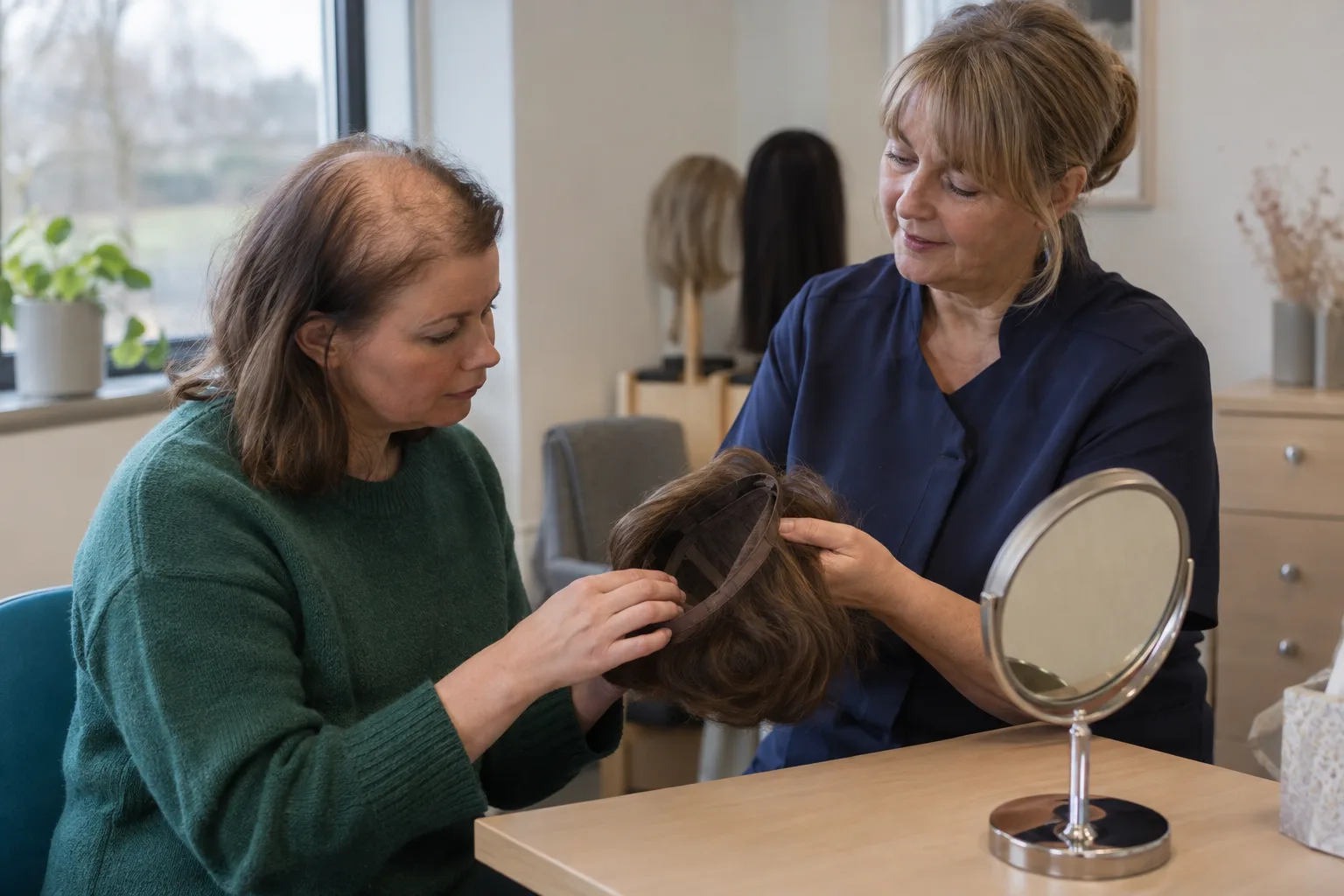
At a fitting, practical questions include whether the cap feels secure, whether it rubs sensitive areas, and what maintenance the fibre needs. Synthetic and human hair wigs can require different care. Follow the instructions supplied with the wig, including any restrictions on heated styling tools.
Comfort deserves particular attention if the scalp is sore or inflamed. A persistent rash, pain or broken skin should not simply be accepted as part of wearing a wig; ask the fitter about fit and seek clinical advice about ongoing symptoms.
If an NHS charge has already been paid and you may have qualified for help, ask the hospital for a receipt identifying it as an NHS payment. The NHS directs refund applicants to complete form HC5(W), available through the NHS Business Services Authority's Low Income Scheme information.
Submitting a form is not the same as having a refund approved. Check which eligibility evidence is needed and whether a claim deadline applies before relying on repayment. Keep the receipt and copies of the information submitted so any query can be followed up.
Finally, arranging camouflage need not wait for every diagnostic question to be resolved, but it should not replace assessment of unexplained loss. Sudden shedding, distinct bald patches or changes to the scalp are worth discussing with a GP. A dermatologist can investigate skin and hair disorders; a trichologist can advise on hair and scalp care.
Why this matters
For people living with hair loss, the cost of a wig can shape whether camouflage feels like a realistic choice. Understanding NHS support helps separate a decision about appearance from avoidable uncertainty about payment, while local checks remain important across the UK. A wig is an option, not an obligation. Our guide to recognising male pattern baldness explains one common cause of thinning. Speak to a GP about new or unexplained loss, a dermatologist about persistent scalp symptoms, or a trichologist for personal hair-care advice.
Common questions
- How much does an NHS wig cost?
- The NHS guidance lists £80.15 for a stock modacrylic wig, £212.35 for a partial human hair wig and £310.55 for a full bespoke human hair wig. Confirm the applicable charge with your local service before paying.
- Who can get a free wig on the NHS?
- Free NHS wigs are available to specified groups, including under-16s, 16-to-18-year-olds in full-time education, hospital inpatients and people with qualifying benefits or valid HC2 entitlement. Eligible war pensioners also qualify. Local arrangements should be checked.
- Can I get a free NHS wig on Universal Credit?
- Possibly, but Universal Credit does not automatically qualify you. You must also meet the relevant NHS health-cost criteria. The NHS Business Services Authority's eligibility checker can help establish whether you are entitled.
- Can I get help with NHS wig costs if I work?
- You may qualify through the NHS Low Income Scheme even without receiving a listed benefit. Eligibility depends on an assessment of income against recognised requirements, with full or partial help available depending on circumstances.
- What does an HC3 certificate cover for an NHS wig?
- An HC3 certificate may reduce the amount you pay. You should be charged the contribution stated on the certificate or the actual NHS wig charge, whichever is lower.
- How do I claim a refund for an NHS wig?
- Ask the hospital for a receipt showing that you paid an NHS charge, then complete form HC5(W). Check eligibility evidence and any deadline with the NHS Business Services Authority. The guidance does not promise refunds for independently purchased private wigs.
- Does wearing a wig treat hair loss?
- No, a wig provides cosmetic coverage rather than treating the cause of hair loss. New, sudden or unexplained loss still deserves assessment, particularly if there are bald patches, pain or other scalp changes.
About the writer
Priya NairResearch Correspondent · Cambridge
Priya translates new hair and scalp research into plain English, explaining how studies were done and how much weight they deserve.
More from PriyaSources
This article is original reporting by Thicker Thinking based on the sources above. Last reviewed 7 October 2026. It is for general information and is not medical advice. Speak to your GP, a dermatologist or a qualified trichologist about your own situation.