Hair Loss Causes
Perifolliculitis capitis abscedens et suffodiens: scarring hair loss
An uncommon but serious scalp disorder can lead to permanent, patchy hair loss if not treated early.
By the Thicker Thinking Editorial Team
Published · 6 min read
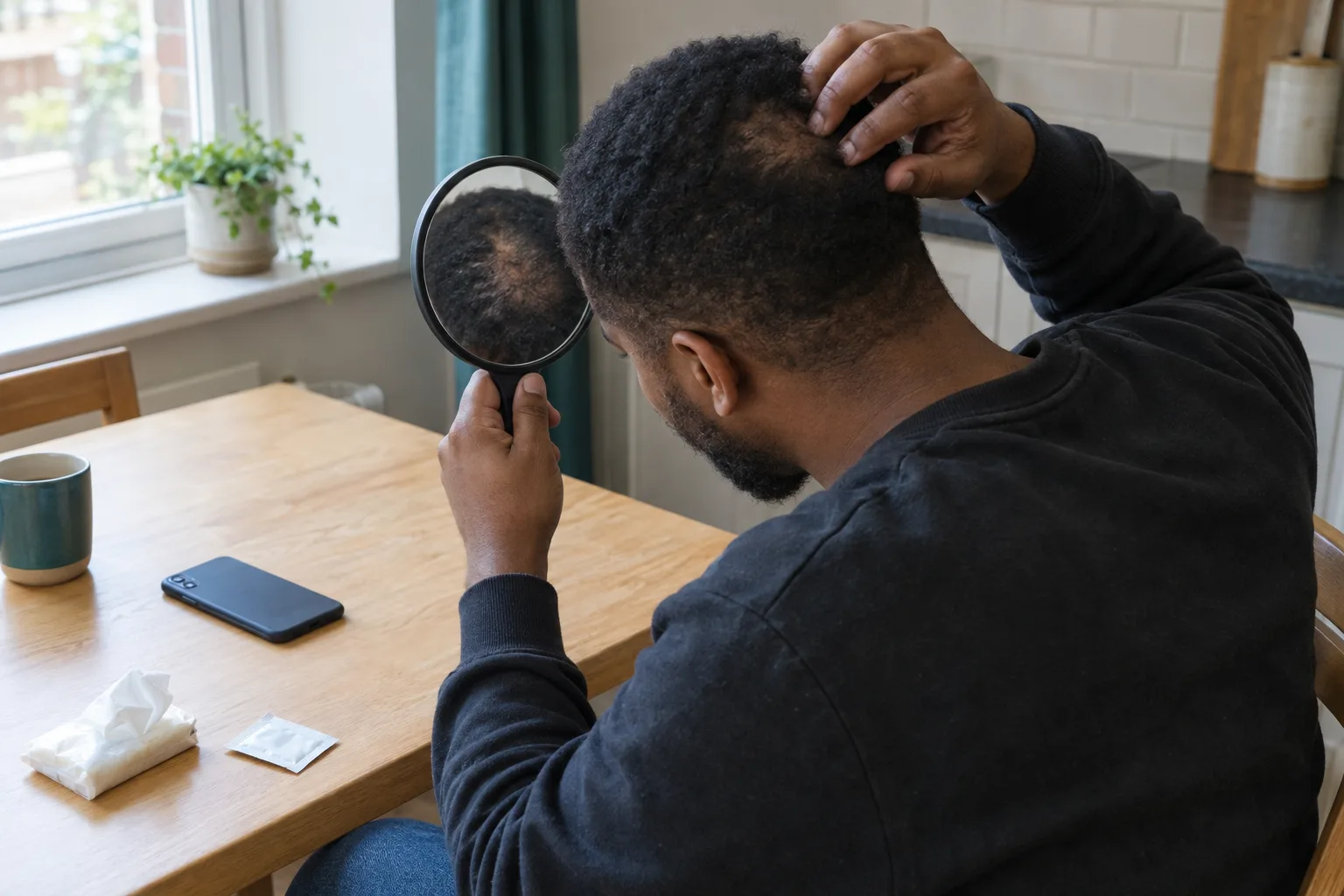
Quick answerPerifolliculitis capitis abscedens et suffodiens, also called dissecting cellulitis of the scalp, is a painful inflammatory scalp disorder that can destroy follicles and cause permanent, patchy hair loss. Early specialist care aims to calm inflammation and limit scarring.
Perifolliculitis capitis abscedens et suffodiens is a rare inflammatory scalp disease that damages hair follicles and can lead to permanent, patchy hair loss. It is also known as dissecting cellulitis of the scalp, and it tends to run a relapsing, long‑term course.
According to DermNet and emedicine.medscape.com, patients typically develop painful pustules, deep nodules and interconnecting sinus tracts that may drain pus or blood, most often over the crown and back of the scalp. Medscape describes the condition as “therapeutically challenging”.
What happened
DermNet and Medscape report that perifolliculitis capitis abscedens et suffodiens (PCAS) is most commonly seen in men of African descent in their second to fifth decades, though it also occurs in women, other ethnic groups and occasionally in children. The male predominance and demographic pattern are consistent findings across clinical summaries.
Clinically, PCAS can involve single or multiple scalp areas and is often painful on examination, with tenderness over active nodules and fluctuant collections. Sinus tracts connect inflamed follicles beneath the skin surface, which helps distinguish it from more superficial folliculitis.
Secondary bacterial infection may complicate flares, with Staphylococcus aureus, Pseudomonas and anaerobes reported by DermNet, while Medscape notes cultures are positive in 12–57% of cases, often isolating S aureus or S epidermidis. Despite this, swabs may be sterile, supporting that infection is usually secondary rather than the primary cause.
PCAS can co‑exist with other disorders in the follicular occlusion spectrum, including hidradenitis suppurativa, nodulocystic acne and pilonidal disease, according to both sources. DermNet also reports associations with arthritis and spondyloarthropathy, with sacroiliitis described in around three‑quarters of affected individuals.
On dermoscopy (a magnified scalp examination), three phases have been described: an early phase mimicking alopecia areata with black dots and broken hairs, an abscedens phase showing large three‑dimensional yellow dots and structureless yellow areas, and a fibrotic phase with white patches lacking follicular openings plus skin clefts containing hair tufts. These features can guide staging and monitoring.
Complications extend beyond scarring alopecia to significant pain during flares and reduced quality of life, DermNet notes. Rarely, cutaneous squamous cell carcinoma has been reported developing within long‑standing, chronically inflamed lesions, underlining the importance of sustained control.
The background
Pathophysiology points to follicular occlusion from abnormal keratinisation, followed by rupture of the follicle and a brisk inflammatory response, according to DermNet. Medscape adds that downstream pathways appear to overlap with hidradenitis suppurativa, implicating tumour necrosis factor‑alpha (TNF‑α) and the interleukin‑23/17 axis in driving chronic inflammation.
Bacteria living on the skin may contribute to inflammation after follicle rupture, particularly coagulase‑negative staphylococci, but both sources emphasise that microbes are not consistently found and are more likely opportunistic than causative. This explains why antiseptics and anti‑inflammatory treatments often have a central role.
Epidemiology studies suggest differing risk correlations across populations. Medscape cites US data linking PCAS with current smoking but not obesity, while Taiwanese data showed the opposite pattern, indicating risk modifiers may vary by setting and study design. No single lifestyle factor has been confirmed as a universal driver.
The condition’s preferred sites are the vertex and occipital scalp, areas with dense hair and large follicles. Disease activity can be patchy, leaving islands of scarring alopecia separated by inflamed tracts, a distribution that helps distinguish it from diffuse non‑scarring shedding such as telogen effluvium.
Diagnosis is primarily clinical, synthesising symptoms, examination and trichoscopy findings. DermNet advises that swabbing any discharge for culture can identify superinfection even though many swabs are sterile, and a skin biopsy—if needed—may show perifollicular neutrophils, abscesses, granulomas and later fibrosis. These steps are also discussed in our guide to folliculitis and hair loss: causes, signs and next steps.
The differential diagnosis includes folliculitis decalvans, in which pustules and scarring occur but deep nodules, sinuses and abscesses are not typical; kerion, which is an inflammatory fungal abscess; bacterial folliculitis; and folliculitis keloidalis nuchae, which favours the nape with firm papules. Careful evaluation aims to avoid overtreating superficial infections or missing deeper pathology.
Scarring alopecias form a broader clinical group, and people may search for answers across multiple labels before a firm diagnosis is reached. For comparison, see our explainer on central centrifugal cicatricial alopecia: causes and signs, which is a distinct pattern but shares the final common pathway of follicle destruction and scarring.
What people are saying
Dermatologists generally advise early referral for any painful scalp breakout with draining tracts or rapid hair loss, as timely anti‑inflammatory treatment can limit follicle destruction. In the UK, a GP can arrange urgent dermatology review, and trichology input may help with scalp care alongside medical therapy.
Specialists commonly start with multi‑pronged measures to settle flares, according to DermNet, including anti‑inflammatory antibiotics (such as tetracyclines or erythromycin), oral isotretinoin, oral or intralesional corticosteroids, analgesia and antiseptic washes. Some teams also consider oral zinc as an adjunct for its anti‑inflammatory effects.
For people with recalcitrant disease or significant comorbidity with hidradenitis suppurativa, Medscape notes growing use of biologic agents targeting TNF‑α or interleukin pathways, including adalimumab. These medicines are specialist‑only and require monitoring due to potential systemic side‑effects.
Surgical options have a place when medical therapy cannot control deep abscesses or established sinus tracts. DermNet lists incision and drainage, limited or wide excision with possible grafting, laser hair removal to reduce follicular targets, carbon dioxide laser ablation, photodynamic therapy and, rarely, radiotherapy in selected cases.
Trichoscopy can be used to track response by phase, with reduction in yellow “soap‑bubble” dots signalling improvement in active abscessing disease, whereas fixed white, featureless areas indicate established scarring that will not regrow hair. Recognising this boundary helps set expectations and focus on preventing new damage.
Scalp care between flares aims to reduce maceration and bacterial overgrowth while avoiding trauma. Dermatologists generally suggest gentle cleansing, avoiding picking or squeezing, and using non‑occlusive hairstyles—principles also echoed in our piece on scalp conditions that cause hair loss: signs and next steps.
Pain, visibility and uncertainty can weigh heavily, and clinicians highlight the value of psychosocial support. Our feature on the psychological effects of hair loss: stress, anxiety and shedding outlines practical coping strategies and when to seek further help.
For people of African and Afro‑Caribbean heritage—who are more often affected—dermatology guidance stresses protective hair practices that minimise scalp friction and inflammation while medical treatment is underway. Our review of Black hair care practices and hair loss: what dermatology says discusses styles and routines that reduce additional strain on the scalp.
What happens next
Both DermNet and Medscape characterise PCAS as chronic, with unpredictable relapses and a risk of extending scarring if inflammation is not controlled. Long‑term plans often combine maintenance medication, prompt management of flares and consideration of procedures to address persistent tracts or symptomatic scarring.
Medscape notes that recent systematic reviews have proposed treatment algorithms to guide clinicians, reflecting increasing—though still limited—evidence for biologics and procedural approaches. Access to these treatments varies, and decisions are individualised based on severity, comorbidities and previous response.
People living with PCAS are advised to monitor for signs of superinfection, such as spreading redness, fever or foul‑smelling discharge, and to seek medical attention quickly if these occur. DermNet underscores that superinfection can complicate the course and may need targeted antibiotics.
Because scarring represents permanent loss of follicles, the focus is on preventing new scarring rather than reversing established bald patches. Surgical reconstruction or camouflage options can be discussed once inflammation is quiet, including grafting in carefully selected, stable areas under specialist care.
Researchers continue to explore the shared inflammatory pathways with hidradenitis suppurativa, raising the prospect of more targeted treatments in future. Understanding which patients respond best to TNF‑α or IL‑23/17 blockade could refine therapy and reduce long‑term tissue damage.
In the meantime, early recognition and sustained follow‑up remain key. If you have painful scalp bumps, draining tracts or sudden patchy shedding, speak to your GP promptly; they can consider referral to dermatology or trichology to confirm the diagnosis and plan treatment.
Why this matters
Scarring alopecias are uncommon but life‑altering because hair does not regrow once follicles are destroyed. Knowing the signs of perifolliculitis capitis abscedens et suffodiens helps people in the UK seek timely care to calm inflammation and limit scarring. A GP can arrange dermatology assessment, and a trichologist can support scalp care while treatments work. Emotional support matters too, as pain and visibility can affect daily life; our guide to the psychological effects of hair loss explains helpful steps and when to ask for more help.
Common questions
- what is perifolliculitis capitis abscedens et suffodiens
- It is a painful inflammatory scalp disorder, also called dissecting cellulitis of the scalp, that forms pustules, nodules and sinus tracts and can cause permanent, patchy scarring hair loss.
- who is most at risk of dissecting cellulitis of the scalp
- According to DermNet and Medscape, it predominantly affects Black men in early to mid‑adulthood, though women, other ethnicities and, rarely, children can also be affected.
- what are the signs and symptoms of perifolliculitis capitis abscedens
- Typical features are painful scalp pustules, deep tender nodules, interconnecting sinus tracts and draining pus or blood, most often on the crown and back of the scalp.
- does perifolliculitis capitis abscedens cause permanent hair loss
- Yes. Inflammation initially causes temporary shedding, but repeated deep inflammation leads to patchy scarring alopecia, which is permanent once follicles are destroyed.
- how is dissecting cellulitis of the scalp diagnosed
- Diagnosis is clinical, supported by trichoscopy. Doctors may swab discharge for culture and sometimes perform a biopsy showing abscesses, granulomas and later fibrosis.
- what treatments are used for perifolliculitis capitis abscedens
- DermNet lists anti‑inflammatory antibiotics, isotretinoin, oral or intralesional steroids, analgesia, antiseptic washes, zinc, and biologics. Surgery, laser and other procedures are options in resistant disease.
- what infections are linked with this scalp condition
- Secondary infection can occur, often with Staphylococcus aureus or Staphylococcus epidermidis. However, many swabs are sterile, showing infection is not always present.
- what other conditions are associated with dissecting cellulitis
- It can co‑occur with hidradenitis suppurativa, nodulocystic acne and pilonidal disease, and DermNet reports frequent association with arthritis and sacroiliac involvement.
Sources
- DermNet: Perifolliculitis capitis abscedens et suffodiens
- emedicine.medscape.com: Perifolliculitis Capitis Abscedens et Suffodiens: Background, Pathophysiology and Etiology, Epidemiology
This article was written by Thicker Thinking using the sources listed above. It is for general information and is not medical advice. Speak to your GP, a dermatologist or a qualified trichologist about your own situation.